
I obtained the credential of Certified Genealogist (SM) in July 2010, but my path to this
designation has been atypical. After graduating from MIT in 1983, I spent several
years training to become an actuary in the local insurance industry. That career
required me to take a lengthy series of detailed examinations, somewhat similar in
spirit to the bar examination, though the complete series can take five to ten years to
pass. Attention to detail was a must, as was a great deal of patience with the
thousands of pages of necessary reading. As it turned out, this was excellent training
for genealogical research.
It is primarily in the last decade or so that I have devoted significant amounts of time
to genealogy, researching ancestry both in New England and in Portugal. My New
England research has given me extensive experience with the wide variety of records
available for New England genealogy from the 1600s to the 1900s: vital and town
records, census records, probate records, land records, New England genealogical
periodicals, Revolutionary War pension files and service records, town histories,
church records, newspaper accounts, and so on.
For my Portuguese research, I entered into an arrangement with the Family History
Library to abstract 35,000 microfilmed parish records (containing 150,000 names).
That experience, while not directly relevant to New England research, exposed me to
a wide variety of handwriting styles from the 1600s to the 1800s, and that experience
has been surprisingly valuable in helping me decipher New England records over
the same period.
designation has been atypical. After graduating from MIT in 1983, I spent several
years training to become an actuary in the local insurance industry. That career
required me to take a lengthy series of detailed examinations, somewhat similar in
spirit to the bar examination, though the complete series can take five to ten years to
pass. Attention to detail was a must, as was a great deal of patience with the
thousands of pages of necessary reading. As it turned out, this was excellent training
for genealogical research.
It is primarily in the last decade or so that I have devoted significant amounts of time
to genealogy, researching ancestry both in New England and in Portugal. My New
England research has given me extensive experience with the wide variety of records
available for New England genealogy from the 1600s to the 1900s: vital and town
records, census records, probate records, land records, New England genealogical
periodicals, Revolutionary War pension files and service records, town histories,
church records, newspaper accounts, and so on.
For my Portuguese research, I entered into an arrangement with the Family History
Library to abstract 35,000 microfilmed parish records (containing 150,000 names).
That experience, while not directly relevant to New England research, exposed me to
a wide variety of handwriting styles from the 1600s to the 1800s, and that experience
has been surprisingly valuable in helping me decipher New England records over
the same period.
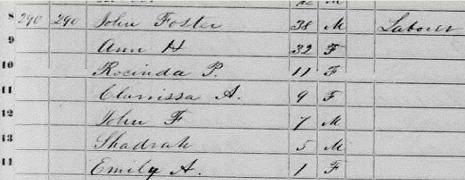
Detail from 1850 federal census population schedule for the family of John and Ann (Hodgkins)
Foster in the town of Gray, Maine (Cumberland County), Series M-432, Roll 249, page 225
(stamped).
Foster in the town of Gray, Maine (Cumberland County), Series M-432, Roll 249, page 225
(stamped).
My New England research originated in the area encompassed by northeastern
Massachusetts, southern New Hampshire, and southern Maine but has since
expanded to all New England states and New York. While each state has its quirks,
research throughout this area generally relies on the same types of records, most of
which are similar across the different jurisdictions. The basic content and wording of
probate records, for example, do not vary much from Massachusetts to New
Hampshire to Vermont to Maine. The same is largely true of town records, land
records, and vital records, and naturally the format of the federal census and other
national records is the same throughout New England.
Massachusetts, southern New Hampshire, and southern Maine but has since
expanded to all New England states and New York. While each state has its quirks,
research throughout this area generally relies on the same types of records, most of
which are similar across the different jurisdictions. The basic content and wording of
probate records, for example, do not vary much from Massachusetts to New
Hampshire to Vermont to Maine. The same is largely true of town records, land
records, and vital records, and naturally the format of the federal census and other
national records is the same throughout New England.
| "A qualified genealogist will obtain all of the facts possible, analyze and judge them carefully, and then and only then, weigh all of the evidence before deciding the crucial problem and accept or reject the facts." -- Noel C. Stevenson, Genealogical Evidence (Revised Edition), p. 12, copyright 1989 by Noel C. Stevenson. |
Copyright 2014 Ruy A. Cardoso. All rights reserved.
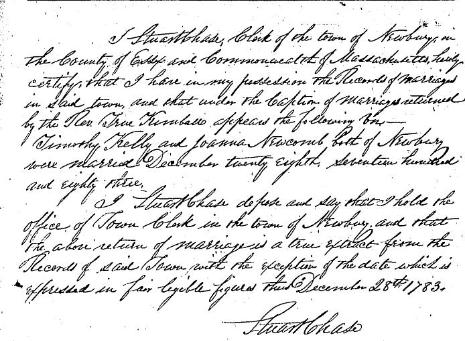
Detail from Revolutionary War pension file W12017, NARA series M-805, roll 490, showing
marriage information for Timothy Kelly and Joanna Newcomb of Newbury, Massachusetts. The
information was provided in an affidavit of Stuart Chase, Newbury town clerk. The same file in
NARA series M-804 includes a complete listing of this couple's children.
marriage information for Timothy Kelly and Joanna Newcomb of Newbury, Massachusetts. The
information was provided in an affidavit of Stuart Chase, Newbury town clerk. The same file in
NARA series M-804 includes a complete listing of this couple's children.
| My Background |

 |
 |
 |
 |
 |

New England Cousins
Ruy Cardoso, Certified Genealogist (SM)
 |